Processor froze your funds? A 48-hour plan
Updated
Card payments stop at the reader, or the payout you expected does not arrive. Then the email: your account is under review, your funds are on hold, a reserve has been set, or the account is closed. One owner on r/smallbusiness described it this way: “After two years of processing payments, with zero notice, and zero reason given Square closed our account Saturday in the middle of the day.” (r/smallbusiness).
This page is a plan for the next 48 hours: what to do at the till today, what to send and ask over the next two days, and what Square, Stripe and PayPal say about holds in their own published terms. It is general information, not legal advice. For the rest of the section, see payments for retail stores.
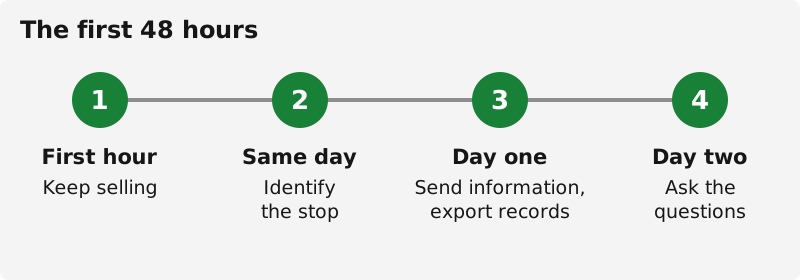
First hour: keep the till open
Section titled “First hour: keep the till open”Customers are at the counter. Deal with them first and the processor second.
- Find out which tills are affected. If you run several locations on one processor account, assume all of them are until you check. Call each location.
- Switch to another processor if you already have one set up. If a second account is connected and a compatible card reader is at the counter, move the registers to it now.
- Take cash. Put a sign at the counter and the door, and tell staff to say it before the customer reaches the till.
- Give staff one line to say. For example: “Our card system is down today, so we can only take cash.” Staff do not need to explain the processor.
- Do not open a new account with the same processor to get around the stop. Stripe’s Services Agreement, for example, forbids attempting “to create a Stripe Account on behalf of or for the benefit of a user whose use of the Stripe services was suspended or terminated by Stripe, unless Stripe approves otherwise” (section 1.2, last modified September 28, 2026).
Be ready for what cash only costs you. In my own stores I had no backup processor, so a stop would have meant cash only. Cash only loses the big sales first: plenty of customers carry some cash, but few carry $500 or $1,000.
Same day: find out what kind of stop it is
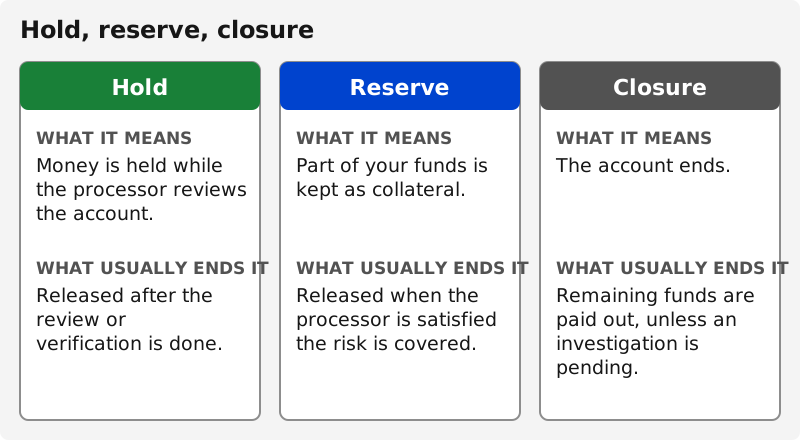
Section titled “Same day: find out what kind of stop it is”The next steps depend on which of these you have:
- A review or hold: payouts or some payments are paused while the processor checks something. Often released after a review or once you verify information.
- A reserve: part of your money is kept back as collateral against refunds and chargebacks, and released when the processor is satisfied the risk is covered.
- A closure: the account ends. Remaining money is paid out, unless an investigation is pending.
Read the notice itself before you call anyone. This is where each processor says to look, and what its terms say about holding money (terms read October 2026):
| Processor | Where the notice appears | What its terms say about holds and reserves |
|---|---|---|
| Square | Email and requests for information. Square “may request additional information from you at any time” (Payment Terms, section 9) | It “may defer payout or restrict access to your Proceeds, temporarily or indefinitely” (section 12) and “may require a Reserve for any reason related to your use of the Services” (section 14). No fixed hold period is stated. (Payment Terms, last updated July 30, 2026) |
| Stripe | Email to the address on the account, and a red banner at the top of the Stripe Dashboard (Stripe support) | Stripe releases reserve funds “only if, and to the extent that, Stripe is satisfied that the relevant risk exposure has been mitigated” (Service Terms, section 3.3, last modified September 28, 2026) |
| PayPal | Email titled “An important message about your PayPal balance”, or an alert on the Account Overview page; “Know your options” under your balance shows why a payment is held | “Your funds are usually held for up to 21 days.” Reserves can be rolling, minimum or jumpstart (PayPal merchant guide, May 2024) |
Write down which kind you have, which payments it covers and the date of the notice. You will need all three tomorrow.
Day one: send what they ask for, and keep records
Section titled “Day one: send what they ask for, and keep records”My view: a processor that suspends an account is not trying to put you out of business. In most cases it needs documents or information, and the request usually says clearly what. The hard part is reaching support when you have a question.
The terms tie suspension to unanswered requests, so answer fast and completely:
- Square: if you refuse a request for information, “your Square Account may be suspended or terminated” (Payment Terms, section 9). Its examples include supplier invoices, a government ID and a business license.
- Stripe: Stripe may suspend a user who “does not promptly respond to Stripe’s request for, or fails to provide, User Information” (Services Agreement, section 10.1).
- PayPal: PayPal “may hold your payments until you’ve finished all the required identity verification steps” (PayPal help).
While you still have access, export your records from the processor’s dashboard: sales, refunds, chargebacks and payout history for at least the last year. If the account closes, you will want them for your books and for any dispute.
Keep a contact log: date, time, channel, the name of the person you reached, what they asked for and what you sent. Send documents through the channel the notice names, and keep copies.
Day two: what to ask
Section titled “Day two: what to ask”When you reach someone, ask:
- Is this a hold, a reserve or a closure?
- Which payments does it cover, and how much money?
- What would release them? Is anything still missing from what I sent?
- When is the next review?
- If it is a reserve: what percentage, is it rolling, and on what schedule is money released?
- If the account is closed: when will the remaining balance be paid out, and is an investigation pending?
If you buy stock ahead for a season, a hold that lasts weeks lands on supplier payments and payroll. Tell suppliers early, before a payment is late.
If someone offers you a new merchant account in a hurry, ask for the term, any equipment lease and the exit fee before you sign. Clover pricing: what the $0 device really costs lists the questions.
Why processors hold or close accounts
Section titled “Why processors hold or close accounts”The reasons in the processors’ own published terms and guides:
- Suspected fraud or unauthorized transactions. Square names “investigations relating to suspected fraud, unauthorized transactions” (section 12). Stripe may suspend when it “reasonably believes User’s activity increases, or may increase, the rate of fraud that Stripe observes” (section 10.1).
- Chargebacks and disputes. Square may delay payouts for pending chargebacks (section 20). PayPal lists cases where several customers report problems or ask for refunds.
- Card network rules. Square requires sellers to follow them, and may withhold network fines or losses from payouts (sections 26 and 30).
- Law and compliance. Square may defer payout “as necessary to comply with applicable law or court order” (section 12).
- Missing information. Square, Stripe and PayPal all tie suspensions or holds to information you have not provided (Square section 9, Stripe section 10.1, and PayPal’s help page on held payments).
- A sudden change in how you sell. PayPal lists “an unexpected surge in sales, a change in business type, a change in average selling price”, and accounts that have not sold in a while.
Processors also keep the right to end the relationship without a reason. Square “may terminate your use of the Payment Services at any time for any reason” (section 37). Stripe “may terminate this Agreement or close User’s Stripe Account at any time” (section 10.1). That is why owners report getting no reason, like the Square owner quoted on r/smallbusiness, while the published terms list many. Knowing the reasons helps you answer a request. It does not mean every hold is right, and the terms do not promise one will be explained.
After the 48 hours: so it does not stop the till again
Section titled “After the 48 hours: so it does not stop the till again”The advice owners give each other is short. One post on r/smallbusiness: “Yes your payments processor is free to freeze your funds at any time, its why you should have operating cash on hand and a backup processor” (r/smallbusiness).
My advice is to keep two or more processor accounts, even if your main one has worked for years. Account age does not make you safe. Use the backup now and then so it is in normal use: PayPal lists both a dormant account and “an unexpected surge in sales” as reasons it may hold payments. And keep operating cash on hand, as that post says, so a hold of a few weeks does not land on supplier payments and payroll.
POS vs payment processor explains how to check whether your POS can run a second processor at all.
Questions store owners ask
Section titled “Questions store owners ask”Can I get my Square account reactivated?
Section titled “Can I get my Square account reactivated?”Answer every request for information quickly and completely; Square’s terms let it suspend or terminate an account when a request is refused (section 9). Square’s terms also say it “may terminate your use of the Payment Services at any time for any reason” (section 37). Square does not publish how many accounts are reactivated.
Can I withdraw money if my account is frozen?
Section titled “Can I withdraw money if my account is frozen?”Not always. Square’s terms let it “defer payout or restrict access to your Proceeds, temporarily or indefinitely” (section 12). After a closure, remaining funds “will be paid out according to your payout schedule”, but if an investigation is pending, Square “may hold your funds” (section 38).
How long does Square hold money for?
Section titled “How long does Square hold money for?”Square’s current Payment Terms (last updated July 30, 2026) do not set a fixed period. A reserve “may be raised, reduced or removed at any time by Square” (section 14), and if you are later found entitled to held funds, Square “will release those funds to you” (section 38).
Why is PayPal holding my funds all of a sudden?
Section titled “Why is PayPal holding my funds all of a sudden?”PayPal lists these reasons: you are a new seller, you have not sold in a while, customers filed disputes or refund requests, your selling pattern changed (such as “a recent spike in sales or a change in your average selling price”), or you sell higher-risk items. It says funds are “usually held for up to 21 days” (PayPal merchant guide, May 2024).
What happens when Stripe closes your account?
Section titled “What happens when Stripe closes your account?”Stripe emails the address on the account with the reason, and the Dashboard shows a red banner. If you think Stripe misunderstood your business, you can ask for another review through the form linked in the email (Stripe support). Money held in a reserve is released when Stripe “is satisfied that the relevant risk exposure has been mitigated” (Service Terms, section 3.3).