Payment processing for retail stores
Updated
This section is for owners of independent retail stores who take card payments. It covers what card processing costs you, how much control you keep over it, and what ties you to one company. Each page starts from a problem a store has after it already has a processor.
My own rule, from the stores I ran: give yourself options. Keep card processing separate from the system that runs your counter. A processor can change its fees or suspend your account, and its fee is a percentage of every sale you make, so a small change in rate adds up fast. Switching is easy when you do it on your own terms. It is hard when you are forced to.
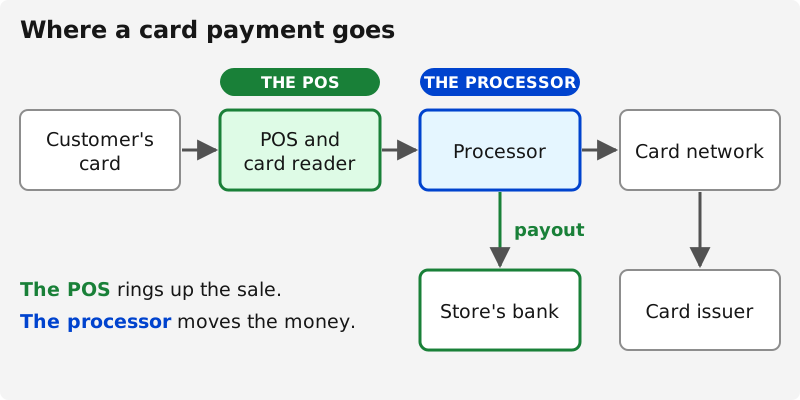
Your POS and your processor are two different things
Section titled “Your POS and your processor are two different things”Your POS (point of sale) runs the counter: items, prices, stock, receipts and staff. Your processor moves the money: it gets the card approved and pays the sale into your bank account. Many systems sell both as one account, which is convenient until one half stops working. One owner’s question on Reddit sums up the search: “Which POS allows you to use an independent processing company?” (r/POS). POS vs payment processor explains the two jobs, why a store should be able to change one without the other, and how to check your own setup.
When a processor holds or freezes your money
Section titled “When a processor holds or freezes your money”Processors can review an account, hold payouts, keep a reserve or close the account under their published terms. It can happen in the middle of a trading day. One owner described a Saturday closure this way: “Having customers waiting in line and no phone support till Monday, we emailed like hell trying to get ahold of someone, anyone, to explain why.” (r/smallbusiness). Processor froze your funds: a 48-hour plan covers what to do at the till in the first hour, what to send and ask over the next two days, and what Square, Stripe and PayPal say in their own terms.
Contracts, leases and early exit fees
Section titled “Contracts, leases and early exit fees”A card terminal can come with up to three agreements: the software, the card processing and the hardware. Each can have its own term, its own exit fee and its own company behind it. Clover pricing: what the $0 device really costs walks through Clover as the example: what its $0 register costs over the term, what you cannot cancel, and what to get in writing.
If you run more than one location
Section titled “If you run more than one location”A processor hold or a contract problem reaches every till at once. One processor account or one POS contract can cover the whole business, so a hold or a fee change can land on every location the same day.
Coming next
Section titled “Coming next”- Card processing fees explained, rate by rate
- How to read a processing statement and find what you actually pay
- Fund holds and reserves: why processors keep money back, and for how long
- Setting up a backup processor
Questions store owners ask
Section titled “Questions store owners ask”How do small businesses process payments?
Section titled “How do small businesses process payments?”A card reader and the POS take the payment at the counter. A processor sends it through the card network to the bank that issued the card for approval. The processor then pays the money, minus its fees, into the store’s bank account.
Can I be my own payment processor?
Section titled “Can I be my own payment processor?”In practice, no. A store works through a processor or a merchant account provider, and its POS has to work with that company. What you can control is which processor you use and whether your POS lets you change it. See POS vs payment processor.
What are the common payment methods used in retail stores?
Section titled “What are the common payment methods used in retail stores?”Cash, cards (tapped, inserted or swiped), mobile wallets such as a phone or watch held to the reader, and gift cards. One counter can take all of them.
What’s the cheapest way to take card payments?
Section titled “What’s the cheapest way to take card payments?”It depends on your mix of cards and your monthly volume, so no single rate is cheapest for every store. Compare the rate, and also the contract: its term, any equipment lease and the exit fee. Those can cost as much as the rate. Clover pricing: what the $0 device really costs shows what to look for.